
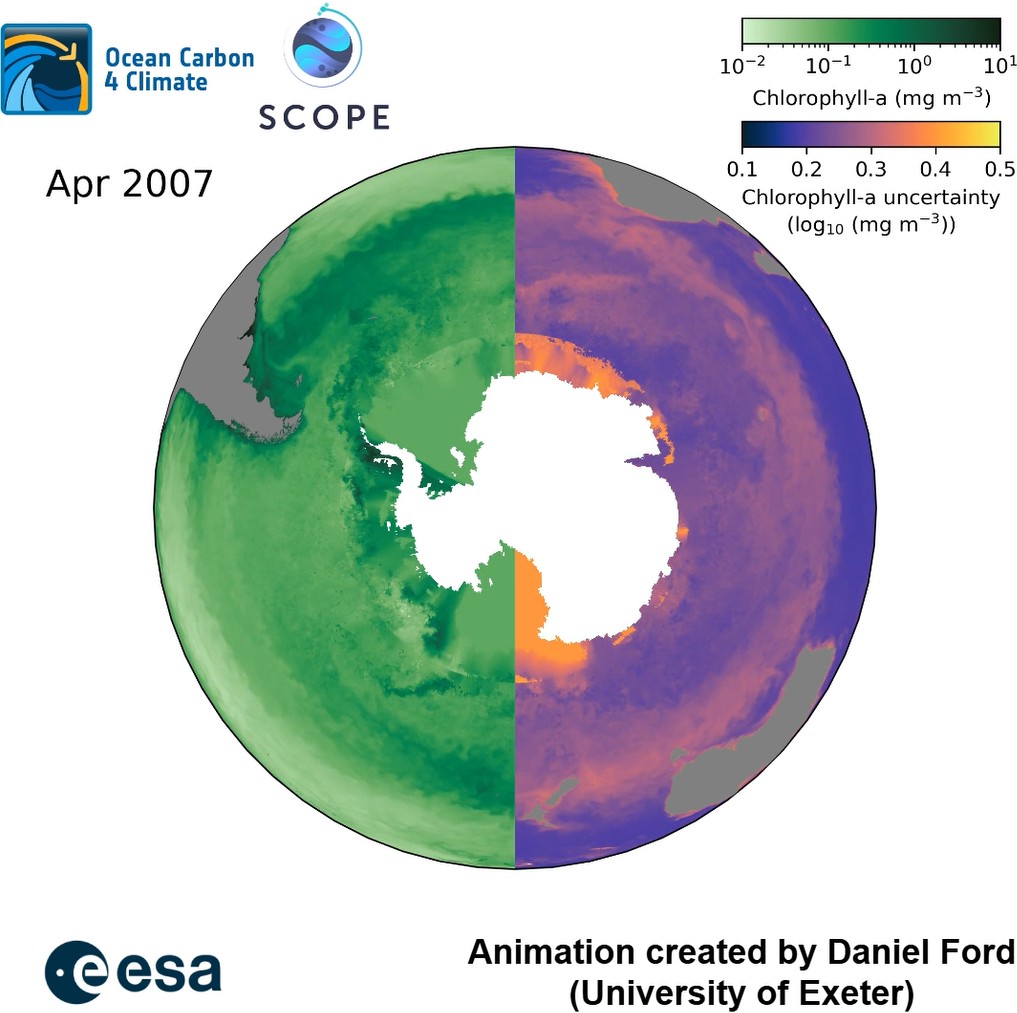
Dan Ford has led a new study published in Earth System Science Data which delivers a 26 year-long, spatially complete global dataset of surface chlorophyll-a (chl-a) by combining satellite observations with in-situ measurements.
Ford, D. J., Kulk, G., Sathyendranath, S., and Shutler, J. D. (2026). Decadal and spatially complete global surface chlorophyll-a data record from satellite and BGC-Argo observations. Earth System Science Data, 18, 569–584.
https://doi.org/10.5194/essd-18-569-2026
Chl-a is recognised as an essential climate variable because it reflects changes in biological activity tied to carbon cycling and marine ecosystem health. Satellites have been monitoring ocean colour — a proxy for chlorophyll-a concentration — since 1997, offering unprecedented insight into global phytoplankton patterns. But satellite data is not perfect: persistent clouds and the long polar winter create substantial gaps in the record, limiting the usefulness of these observations for climate studies and large-scale models.
To address these limitations, Dan and colleagues developed a method that fuses satellite data with observations from Biogeochemical Argo (BGC-Argo) floats — robotic platforms that drift with ocean currents and sample water properties, including chlorophyll-a, at various depths.
The result is a monthly global dataset from 1997 through 2024 at a resolution of 0.25°, complete across all seasons and regions — including high latitudes that were previously missing.
The full global dataset can be found here via Zenodo and is shown as an animation below.