
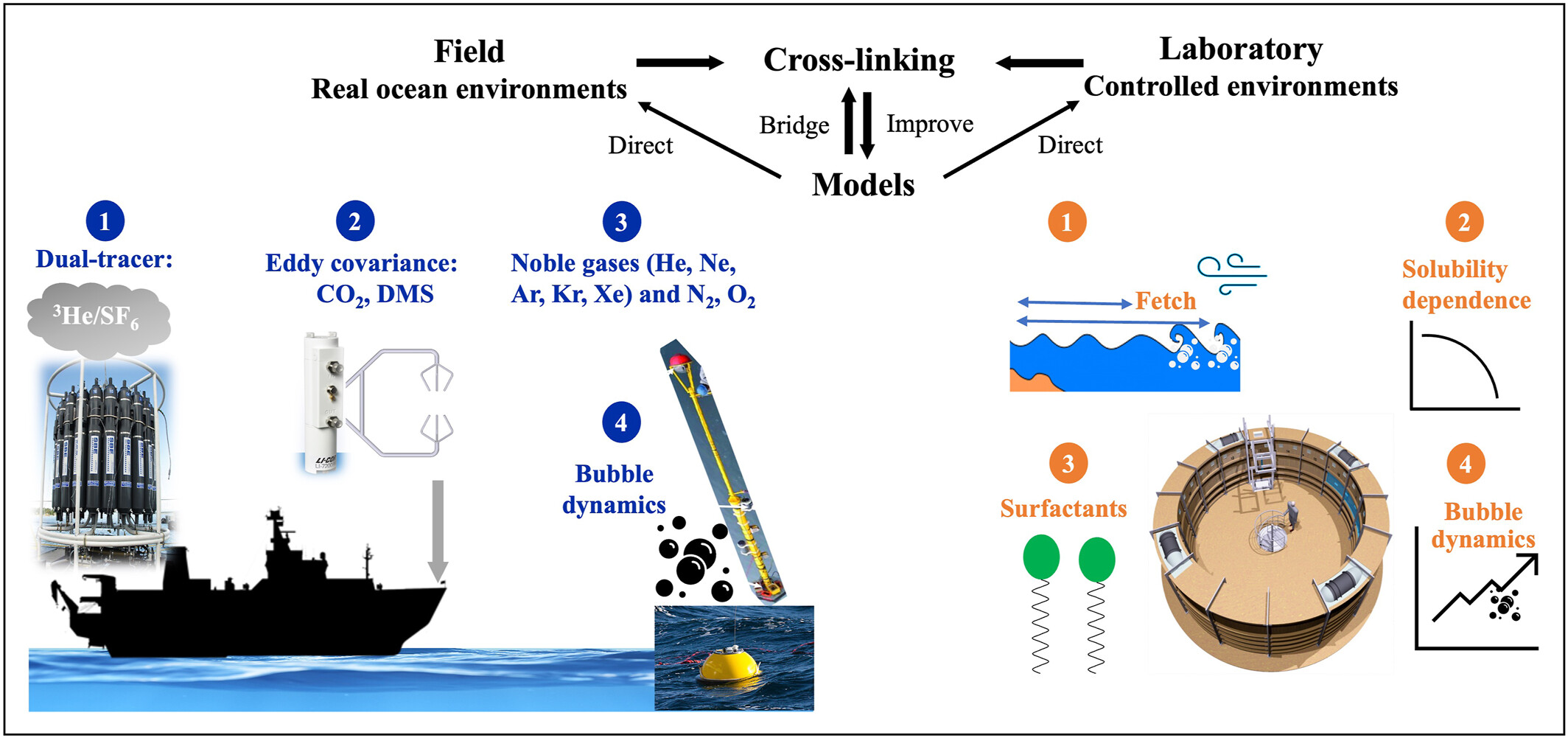
Image shows ‘Cross-linking laboratory experiments, field observations, and models to improve quantification of bubble-mediated air-sea gas transfer across gases with different solubilities.’
Read more about this recently published review article, featuring contributions from OC4C project researcher Professor David Woolf. See abstract below.
Dong, Y., Jähne, B., Woolf, D. K., Krall, K. E., Yang, M., Czerski, H., et al. (2026). The role of bubbles in air-sea gas exchange: A critical review. Reviews of Geophysics, 64, e2025RG000903. https://doi.org/10.1029/2025RG000903
Abstract
Air-sea gas exchange regulates the exchange of climatically important gases between the ocean and the atmosphere, shaping both climate and ocean biogeochemistry. Bubbles beneath the sea surface enhance this exchange by introducing an additional transfer pathway in parallel to the interfacial transfer route. Although the role of bubbles in gas flux has been debated since the 1980s, recent advances in laboratory experiments, field observations, and modeling have provided new insights. Bubble-mediated gas transfer differs from interfacial transfer in three key ways: (a) it shows strong nonlinearity with wind speed due to its link with wave breaking; (b) it depends on gas solubility because of the finite volume and short lifetime of bubbles; and (c) it shifts the equilibrium toward slight oversaturation through the overpressure of submerged bubbles. These characteristics make bubble-mediated gas transfer complicated to quantify, and existing observations and models indicate a wide range of bubble contributions to air-sea carbon dioxide and oxygen exchange. Three critical knowledge gaps are identified: (a) limited understanding of near-surface (0–1 m) bubble dynamics, including volume flux, size distribution, and evolution, which directly control the solubility and diffusivity dependence of bubble-mediated gas exchange; (b) the absence of consistent field constraints spanning the full range of gas solubilities; and (c) the lack of knowledge to scale laboratory results to oceanic conditions. Addressing these gaps will require integrated efforts combining near-surface bubble measurements and simulations, field observations of gas transfer across diverse solubilities using complementary techniques, and improved modeling frameworks.